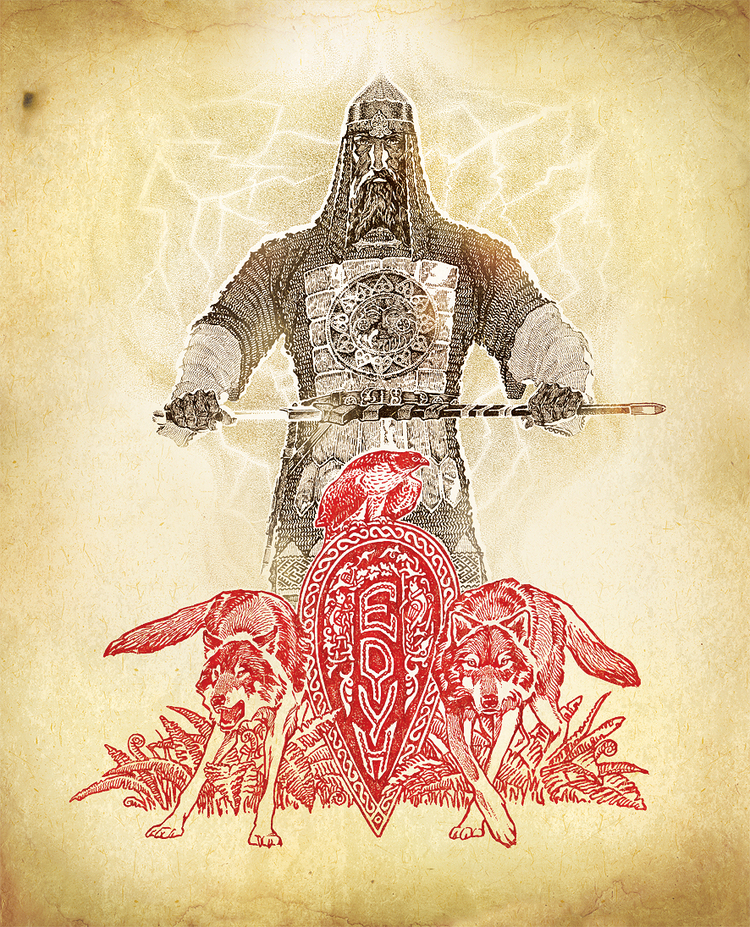
A portrait of the universe god, Perun

Perun, Slavic God of the Sky and Universe


Perun in Slavic Mythology

Perun was the supreme god of the pre-Christian Slavic pantheon, although there is evidence that he supplanted Svarog (the god of the sun) as the leader at some point in history. Perun was a pagan warrior of heaven and patron protector of warriors. As the liberator of atmospheric water (through his creation tale battle with the dragon Veles), he was worshipped as a god of agriculture, and bulls and a few humans were sacrificed to him.

In 988, the leader of the Kievan Rus' Vladimir I pulled down Perun's statue near Kyiv (Ukraine) and it was cast into the waters of the Dneiper River. As recently as 1950, people would cast gold coins in the Dneiper to honor Perun.

Appearance and Reputation

Perun is portrayed as a vigorous, red-bearded man with an imposing stature, with silver hair and a golden mustache. He carries a hammer, a war ax, and/or a bow with which he shoots bolts of lightning. He is associated with oxen and represented by a sacred tree—a mighty oak. He is sometimes illustrated as riding through the sky in a chariot drawn by a goat. In illustrations of his primary myth, he is sometimes pictured as an eagle sitting in the top branches of the tree, with his enemy and battle rival Veles the dragon curled around its roots.

Perun is associated with Thursday—the Slavic word for Thursday "Perendan" means "Perun's Day"—and his festival date was June 21.

Was Perun Invented by the Vikings?

There is a persistent tale that a tsar of the Kievan Rus, Vladimir I (ruled 980–1015 CE), invented the Slavic pantheon of gods out of a blend of Greek and Norse tales. That rumor arose out of the 1930s and 1940s German Kulturkreis movement. German anthropologists Erwin Wienecke (1904–1952) and Leonhard Franz (1870–1950), in particular, were of the opinion that the Slavs were incapable of developing any complex beliefs beyond animism, and they needed help from the "master race" to make that happen.

Vladimir I did, in fact, erect statues of six gods (Perun, Khors, Dazhbog, Stribog, Simargl, and Mokosh) on a hill near Kyiv, but there is documentary evidence that the Perun statue existed there decades earlier. The statue of Perun was larger than the others, made of wood with a head of silver and a mustache of gold. Later he removed the statues, having committed his countrymen to convert to Byzantine Greek Christianity, a very wise move to modernize the Kievan Rus' and facilitate trade in the region.

However, in their 2019 book "Slavic Gods and Heroes," scholars Judith Kalik and Alexander Uchitel continue to argue that Perun may have been invented by the Rus' between 911 and 944 in the first attempt to create a pantheon in Kyiv after Novgorod was replaced as the capital city. There are very few pre-Christian documents related to the Slavic cultures which survive, and the controversy may never be sufficiently resolved to everyone's satisfaction.

Ancient Sources for Perun

The earliest reference to Perun is in the works of the Byzantine scholar Procopius (500–565 CE), who noted that the Slavs worshipped the "Maker of Lightning" as the lord over everything and the god to whom cattle and other victims were sacrificed.

Perun appears in several surviving Varangian (Rus) treaties beginning in 907 CE. In 945, a treaty between the Rus' leader Prince Igor (consort of Princess Olga) and the Byzantine emperor Constantine VII included a reference to Igor's men (the unbaptized ones) laying down their weapons, shields, and gold ornaments and taking an oath at a statue of Perun—the baptized ones worshipped at the nearby church of St. Elias. The Chronicle of Novgorod (compiled 1016–1471) reports that when the Perun shrine in that city was attacked, there was a serious uprising of the people, all suggesting that the myth had some long-term substance.

Primary Myth

Perun is most significantly tied to a creation myth, in which he battles Veles, the Slavic god of the underworld, for the protection of his wife (Mokosh, goddess of summer) and the freedom of atmospheric water, as well as for the control of the universe.

Post-Christian Changes

After Christianization in the 11th century CE, Perun's cult became associated with St. Elias (Elijah), also known as the Holy Prophet Ilie (or Ilija Muromets or Ilja Gromovik), who is said to have ridden madly with a chariot of fire across the sky, and punished his enemies with lightning bolts.
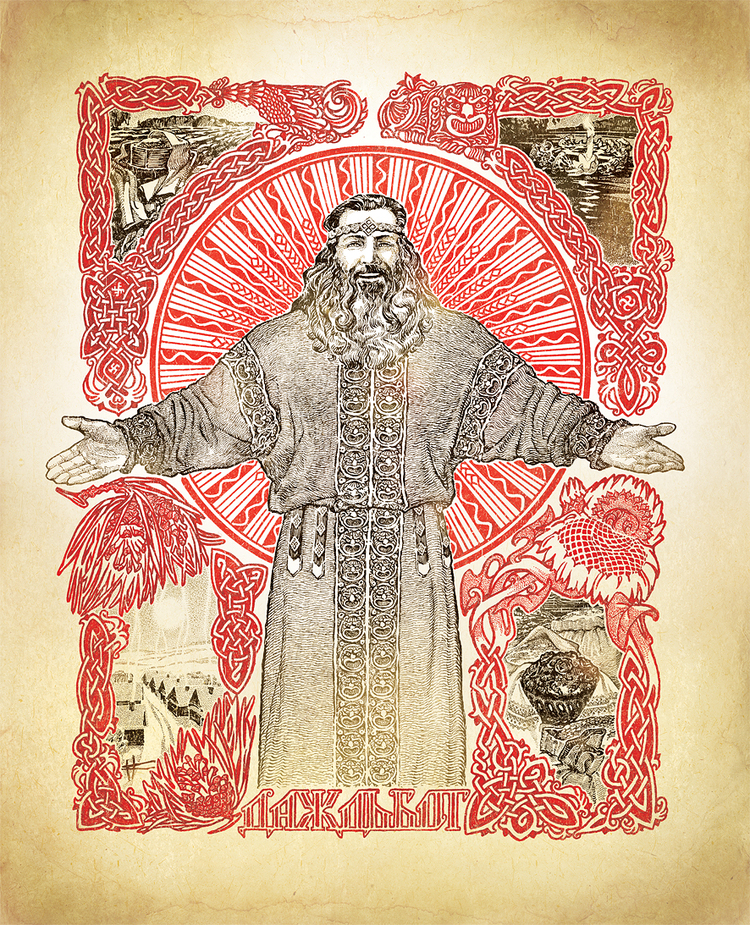
A portrait of the sun god, Dazbog

Dazbog, Slavic God of the Sun


Dazbog (spelled Dahzbog, Dzbog, or Dazhd'bog) is said to have been the god of the sun in the pre-Christian Slavic culture, who drove across the sky in a golden chariot drawn by fire-breathing horses—which sounds just a bit too much like ancient Greek, raising doubt among scholars about his true origins.

Dazbog in Slavic Mythology

Dazbog was the Slavic sun god, a role that is common to many Indo-European people, and there is ample evidence that there was a sun cult in the pre-Christian tribes of central Europe. His name means "day god" or "giving god," to different scholars—"Bog" is generally accepted to mean "god," but Daz means either "day" or "giving."

The primary tale about Dazbog is that he resided in the east, in a land of everlasting summer and plenty, in a palace made of gold. The morning and evening auroras, known collectively as Zorya, were his daughters. In the morning, Zorya opened the palace gates to allow Dazbog to leave the palace and begin his daily journey across the sky; in the evening, Zorya closed the gates after the sun returned in the evening.

Appearance and Reputation

Dazbog is said to ride across the sky in a golden chariot drawn by fire-breathing horses who are white, gold, silver, or diamonds. In some tales, the horses are beautiful and white with golden wings, and sunlight comes from the solar fire shield Dazbog always carries with him. At night, Dazbog wanders the sky from east to west, crossing the great ocean with a boat pulled by geese, wild ducks, and swans.

In some tales, Dazbog starts out in the morning as a young, strong man but by the evening he is a red-faced, bloated elderly gentleman; he is reborn every morning. He represents fertility, male power, and in "The Song of Igor's Campaign" he is mentioned as the grandfather of the Slavs.

Family

Dazbog is said to be the son of the sky god Savrog, and the brother to Svarozhich, the fire god. He is married to the moon Mesyats in some tales (Mesyat is sometimes male and sometimes married to the Zevyi), and his children include the Zoryi and the Zevyi.

The Zoryi are two or three siblings who open the gates to Dazbog's palace; the two Zevyi are responsible for tending to the horses. In some stories, the Zevyi sisters are conflated with the single goddess of light Zorya.

Pre-Christian Aspect Pre-Christian Slavic mythology has very little extant documentation, and the existing tales captured by ethnologists and historians come from multiple modern countries and have many different variations. Scholars are divided about the role of Dazbog to the pre-Christians.

Dazbog was one of the six gods selected by the Kievan Rus' leader Vladimir the Great (ruled 980–1015) as the main pantheon of Slavic culture, but his role as the sun god has been questioned by historians Judith Kalik and Alexander Uchitel. The major source for the assignation of the name of Dazbog with the sun god is the Russian translation of the sixth-century Byzantine monk John Malalas (491–578). Malalas included a story about the Greek gods Helios and Hephaistos ruling Egypt, and the Russian translator replaced the names with Dazbog and Svarog.

There's no doubt that there was a solar cult in pre-Christian Slavic mythology, and there is no doubt that there was a Dazbog, who was among the idols erected by the Rus leader Vladimir the Great in the late 10th century. Kalik and Uchitel argue that to the Slavic pre-Christians, Dazbog was a god of unknown powers, and the unnamed solar deity was the head of a cult. Other historians and ethnologists do not agree.

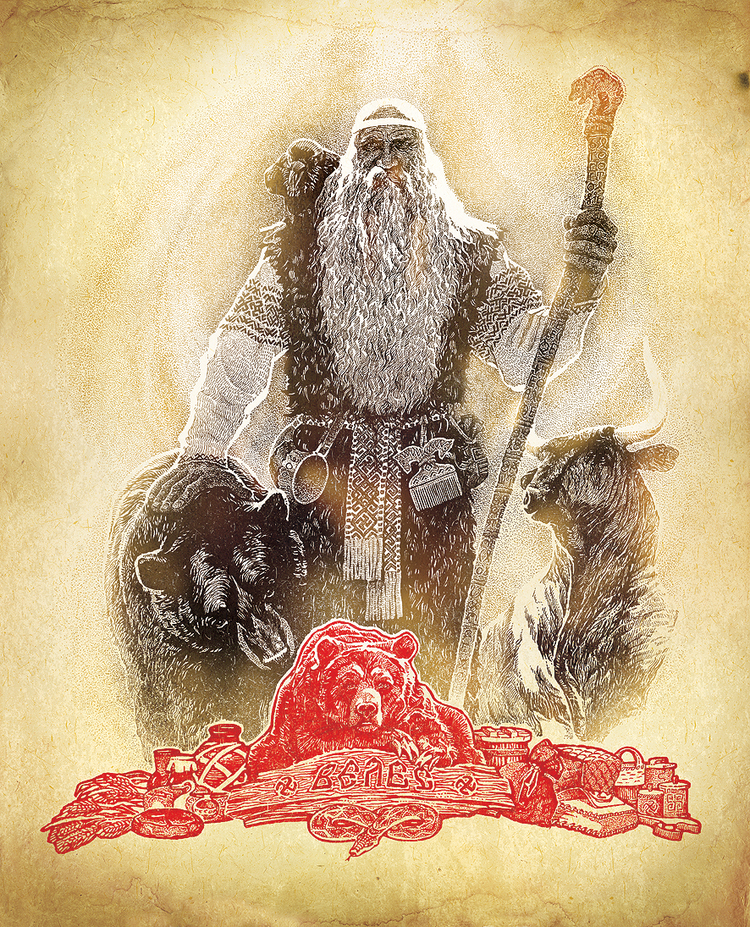
A protrait of the underworld god, Veles

Veles, Slavic God of Cattle and the Underworld


Veles, or Volos, is the name of the pre-Christian Slavic God of Cattle, who in addition to his role as protector of domestic animals, was also the God of the Underworld and the bitter enemy of Perun, the Slavic God of Thunder.

Veles in Slavic Mythology

The earliest reference to Veles is in the Rus-Byzantine Treaty of 971, in which the signers must swear by Veles' name. Violators of the treaty are warned of a menacing punishment: they will be killed by their own weapons and become "yellow as gold," which some scholars have interpreted as "cursed with a disease." If so, that would imply a connection to the Vedic god Varuna, also a cattle god who could send diseases to punish miscreants.

Veles is associated with a wide variety of powers and protectors: he is associated with poetry and wisdom, the lord of the waters (oceans, seas, ships, and whirlpools). He is both the hunter and protector of cattle and the lord of the underworld, a reflection of the Indo-European concept of the netherworld as a pasture. He is also related to an ancient Slavic cult of the deceased soul; the ancient Lithuanian term "welis" means "dead" and "welci" means "dead souls."

Appearance and Reputation

Although few images exist, Veles is generally portrayed as a bald human man, sometimes with bull horns on his head. In the epic creation battle between Velos and Perun, however, Veles is a serpent or dragon lying in a nest of black wool or on a black fleece beneath the World Tree; some scholars have suggested he was a shape-shifter.

In addition to domestic horses, cows, goats, and sheep, Veles is associated with wolves, reptiles, and black birds (ravens and crows).

Cosmic Battle Between Perun and Veles

The best-known myth of Veles is found in several versions, or fragments of versions, from the various cultures claiming descent from the Kievan Rus'. The tale is a creation myth, in which Veles abducts Mokosh (the Goddess of Summer and consort of Perun, God of Thunder). Perun and his enemy battle for the universe under a huge oak, Perun's holy tree, similar to both Greek and Norse (Yggdrasil) mythologies. The battle is won by Perun, and afterward, the waters of the world are set free and flowing.

Separating the Human and Nether Worlds

A second creation myth associated with Veles is the formation of the boundary between the underworld and the human world, a result of a treaty forged between Veles and a shepherd/magician.

In the treaty, the unnamed shepherd pledges to sacrifice his best cow to Veles and keep many prohibitions. Then he divides the human world from the wild underworld led by Veles, which is either a furrow plowed by Veles himself or a groove across the road carved by the shepherd with a knife which the evil powers cannot cross.

Post-Christian Changes

There are many possibly recognizable vestiges of Veles remaining in the Slavic mythology after Vladimir the Great brought Christianity to the Rus' in 988. Velia remains a feast of the dead in old Lithuanian, celebrating the border between the world of the living and the world of the dead, with Veles operating as a role of guiding souls to the underworld.

The battle between Perun (Ilija Muromets or St. Elias) and Veles (Selevkiy) is found in many different forms, but in later stories, instead of gods, they are complementary figures separated from one another by a furrow plowed by Christ, who converts them. Veles is also likely represented by St. Vlasii, depicted in Russian iconography as surrounded by sheep, cows, and goats.

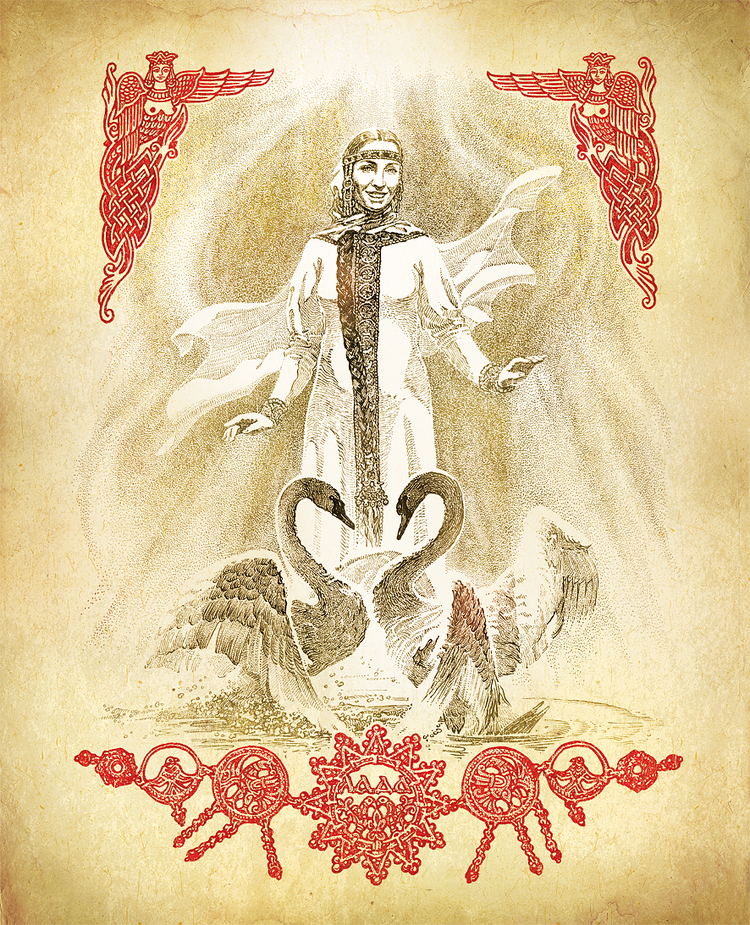
A portrait of the love goddess, Lada

Lada, Slavic Goddess of Spring and Love


Lada, the Slavic goddess of spring, was worshipped at the end of winter. She is similar to the Norse Freyja and the Greek Aphrodite, but some modern scholars think she was an invention of anti-pagan clerics in the 15th century.

Lada in Slavic Mythology

In Slavic mythology, Lada is the counterpart of the Scandinavian goddess Freyja and the Greek Aphrodite, the goddess of spring (and the end of winter) and of human desire and eroticism. She is paired with Lado, her twin brother, and said to be a mother goddess to some Slavic groups. Her worship is said to have been transferred to the virgin Mary after the Kievan Rus converted to Christianity.

However, recent scholarship suggests Lada was not a pre-Christian Slavic goddess at all, but rather a construct of anti-pagan clerics in the 15th and 16th centuries, who based their tales on Byzantine, Greek, or Egyptian stories and intended to denigrate cultural aspects of the pagan culture.

Appearance and Reputation

Lada doesn't appear in pre-Christian texts—but there are very few that survive. In the 15th and 16th century records where she first appears, Lada is the vernal goddess of love and fertility, overseer of the harvests, protector of lovers, couples, marriage and family, women and children. She is illustrated as a voluptuous woman in the prime of life, full-bodied, mature, and a symbol of motherhood.

The word form "Lad" means "harmony, understanding, order" in Czech, and "order, beautiful, cute" in Polish. Lada appears in Russian folk songs and is described as a tall woman with a wave of golden hair wreathed as a crown on her head. She is the embodiment of divine beauty and eternal youth.

18th Century Tale of Lada

Pioneering Russian novelist Michail Čulkov (1743–1792) used Lada in one of his tales, based in part on Slavic mythology. "Slavenskie skazki" ("Tales of Desire and Discontent") includes a story in which the hero Siloslav seeks his beloved Prelepa, who has been abducted by an evil spirit. Siloslav reaches a palace in which he finds Prelesta lying naked in a seashell filled with foam as if she were the goddess of love. Cupids hold a book over her head with the inscription "Wish and it shall be" on it. Prelesta explains that her kingdom is solely occupied by women and so here he may find the unlimited satisfaction of all his sexual desires. Eventually, he arrives at the palace of the goddess Lada herself, who chooses him to be her lover and invites him into her bedroom where she fulfills her own desires and those of the gods.

Siloslav discovers that the reason the kingdom has no men is that Prelesta committed adultery with the evil spirit Vlegon, causing the deaths of all of the men in the kingdom, including her husband Roksolan. Siloslav turns down Prelesta's offer, and instead defeats Vlegon, procuring the resurrection of Roksolan and his men. At last, Siloslav finds his Prelepa and kisses her only to discover she is Vlegon in disguise. Further, he soon finds that the goddess Lada is not herself either, but a hideous old witch who has taken on the appearance of the goddess.

Was There a Slavic Goddess Lada?

In their 2019 book, "Slavic Gods and Heroes," historians Judith Kalik and Alexander Uchitel argue that Lada is one of several "phantom gods," added into the Slavic pantheon by anti-pagan clerics during the medieval and late modern period. These myths were often based on Byzantine prototypes, and the names of Slavic gods appear as translations of the names of Greek or Egyptian gods. Other versions are taken from modern Slavic folklore, which Kalik and Uchitel suggest have no clear signs of origin date.

Kalik and Uchitel argue that the name "Lada" derives from a meaningless refrain "lado, lada" that appears in Slavic folk songs, and was cobbled into a paired set of gods. In 2006, Lithuanian historian Rokas Balsys commented that the question of authenticity of the goddess is unresolved, that although there is no doubt that many investigators have assumed she existed based solely on 15th-21st century sources, there are some rituals in the Baltic states that seem to be adoration of a winter goddess named Lada, during the "ledu dienos" (days of hail and ice): those are the rituals which include the "Lado, Lada" refrain.

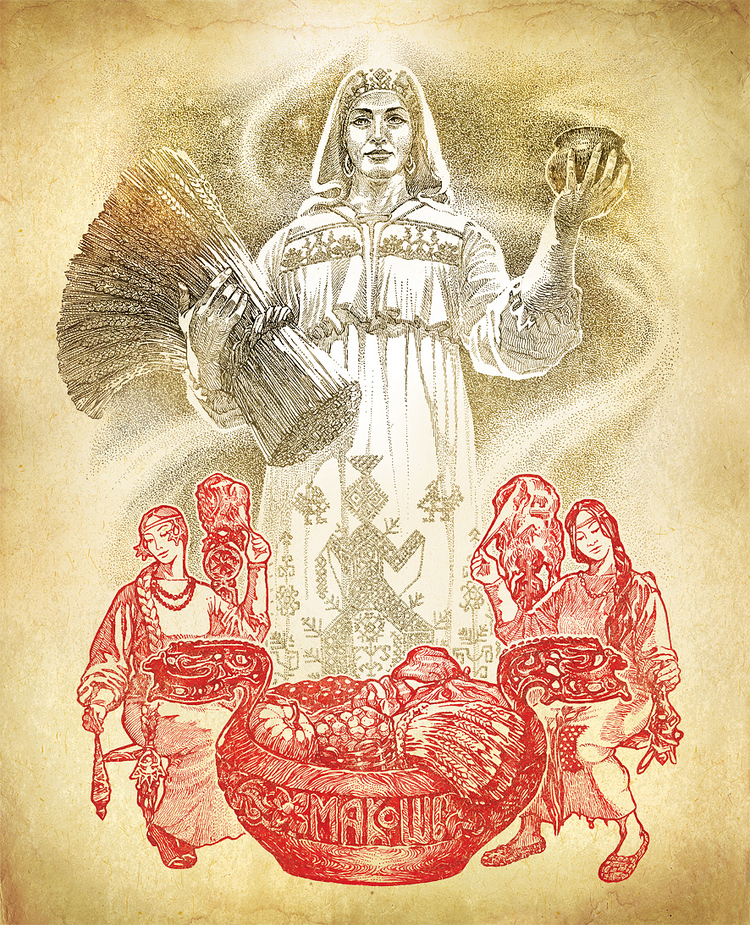
A portrait of the earth goddess, Mokosh

Mokosh, Slavic Mother Earth Goddess


There are seven primordial gods in Slavic mythology, and only one of them is female: Mokosh. In the pantheon in the Kievan Rus' state, she is the only goddess at all, and so her specific role in Slavic mythology is vast and varied, and, more aptly perhaps, foggy and damp. Mother earth and house spirit, tender of sheep and spinner of fate, Mokosh is the supreme Slavic goddess.

Mokosh in Slavic Mythology

In Slavic mythology, Mokosh, sometimes transliterated as Mokoš and meaning "Friday," is Moist Mother Earth and thus the most important (or sometimes only) goddess in the religion. As a creator, she is said to have been discovered sleeping in a cave by a flowering spring by the spring god Jarilo, with whom she created the fruits of the earth. She is also the protector of spinning, tending sheep, and wool, patron of merchants and fishermen, who protects cattle from plague and people from drought, disease, drowning, and unclean spirits.

The origins of Mokosh as mother earth may date to pre-Indo-European times (Cuceteni or Tripolye culture, 6th–5th millennia BCE) when a near-global woman-centered religion is thought to have been in place. Some scholars suggest she may be a version of Finno-Ugric sun goddess Jumala.

In 980 CE, Kievan Rus emperor Vladimir I (died 1015) erected six idols to Slavic gods and included Mokosh in 980 CE, although he took them down when he converted to Christianity. Nestor the Chronicler (11th century CE), a monk at the Monastery of the Caves in Kyiv, mentions her as the only female in his list of seven gods of the Slavs. Versions of her are included in the tales of many different Slavic countries.

Appearance and Reputation

Surviving images of Mokosh are rare—although there were stone monuments to her beginning at least as long ago as the 7th century. A wooden cult figure in a wooded area in the Czech Republic is said to be a figure of her. Historical references say she had a large head and long arms, a reference to her connection with spiders and spinning. Symbols associated with her include spindles and cloth, the rhombus (a nearly global reference to women's genitals for at least 20,000 years), and the Sacred Tree or Pillar.

There are many goddesses in the various Indo-European pantheons who reference spiders and spinning. Historian Mary Kilbourne Matossian has pointed out that the Latin word for tissue "textere" means "to weave," and in several derivative languages such as Old French, "tissue" means "something woven."

The act of spinning, suggests Matossian, is to create body tissue. The umbilical cord is the thread of life, transmitting moisture from the mother to the infant, twisted and coiled like the thread around a spindle. The final cloth of life is represented by the shroud or "winding sheet," wrapped around a corpse in a spiral, as thread loops around a spindle.

Role in Mythology

Although the Great Goddess has a variety of consorts, both human and animal, in her role as a primary Slavic goddess, Mokosh is the moist earth goddess and is set against (and married to) Perun as the dry sky god. She is also linked to Veles, in an adulterous manner; and Jarilo, the spring god.

Some Slavic peasants felt it was wrong to spit on the earth or beat it. During the Spring, practitioners considered the earth pregnant: before March 25 ("Lady Day"), they would neither construct a building or a fence, drive a stake into the ground or sow seed. When peasant women gathered herbs they first lay prone and prayed to Mother Earth to bless any medicinal herbs.

Mokosh in Modern Usage

With the coming of Christianity into the Slavic countries in the 11th century CE, Mokosh was converted to a saint, St. Paraskeva Pyanitsa (or possibly the Virgin Mary), who is sometimes defined as the personification of the day of Christ's crucifixion, and others a Christian martyr. Described as tall and thin with loose hair, St. Paraskeva Pyanitsa is known as "l'nianisa" (flax woman), connecting her to spinning. She is the patroness of merchants and traders and marriage, and she defends her followers from a range of diseases.

In common with many Indo-European religions (Paraskevi is Friday in modern Greek; Freya = Friday; Venus=Vendredi), Friday is associated with Mokosh and St. Paraskeva Pyanitsa, especially Fridays before important holidays. Her feast day is October 28; and no one may spin, weave, or mend on that day.

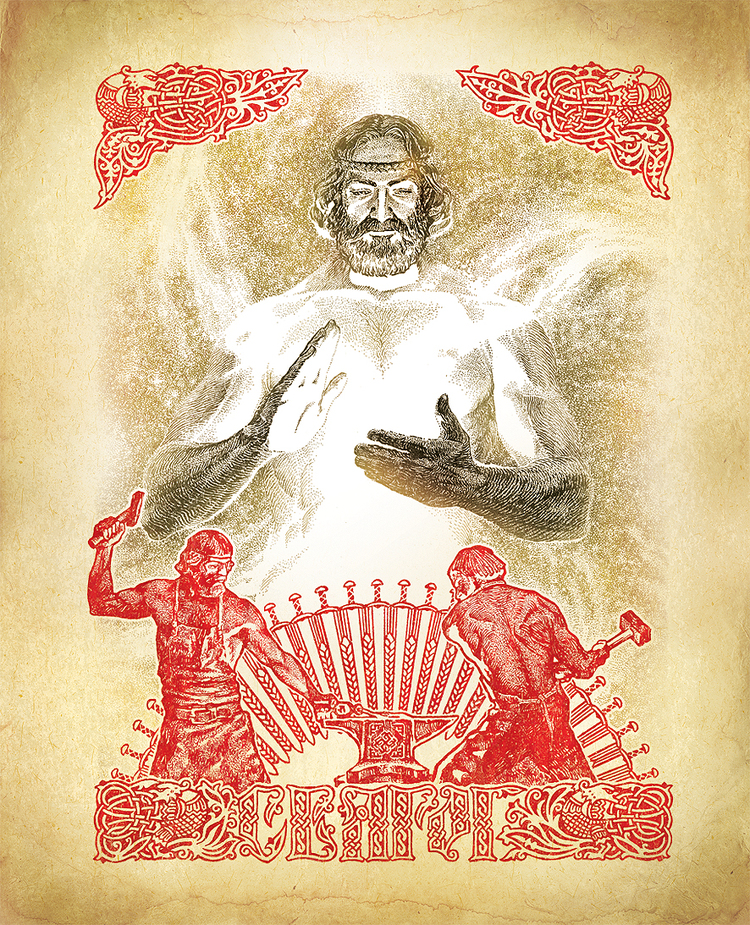
A portrait of the sky god, Svarog

Svarog, Slavic God of the Sky


In pre-Christian Slavic mythology, Svarog was a creator god who ruled the sky and fathered the gods of fire and sun, before retiring to indolence and turning the ruling of the universe over to his two sons.

Svarog in Slavic Mythology

There are very few traces of pre-Christian Slavic mythology which have survived to present day, but apparently Svarog's name is derived from Sanskrit ("Sur" or "shine") and Vedic "Svar," which means "shines" or "gleams" and "svarg" which means "heaven." It may have been an Iranian loan word, rather than direct from India.

Svarog was apparently a passive sky god, which echoes a fairly widely represented Indo-European tradition, including the Greek god Uranos, who became incapacitated after the world was created. According to writer Mike Dixon-Kennedy, there were a number of temples dedicated to Svarog, where armies would lay their standards after battles, and where animals and perhaps humans were sacrificed in Svarog's name.

Textual Sources

The earliest reference to Svarog is in the Hypatian Codex, a 15th-century Russian collection of earlier documents that included a translation of the Byzantine cleric and chronicler John Malalas (491–578). In his work "Chronographia," Malalas wrote of tales of the Greek gods of Hephaistos and Helios and the time they spent ruling Egypt; the Russian translator replaced the name "Hephaistos" with "Svarog" and the name "Helios" with "Dazhbog."

"After [Hermes], Hephaistos reigned over the Egyptians for 1,680 days, ...they called Hephaistos a god, for he was a fighting man with mystic knowledge (who) through a mystic prayer received tongs from the air for the manufacture of implements of iron... After the death of Hephaistos, his son Helios reigned over the Egyptians for 12 years and 97 days..." Malalas is not considered a particularly good scholar, and the sources he accessed were not terribly reliable. However, he was popular at the time, and was writing for a popular audience. Further, it is difficult to say what his Russian translator knew, and it seems unlikely that he was matching Slavic stories to Malalas'. But it does make some sense that, aware of the existing Slavic mythology, he introduced two existing Slavonic deities associated with fire, rather than inventing two on the spot.

Possible Evidence

The evidence for Svarog as a real pre-Christian Slavic god is slim—historians Judith Kalik and Alexander Uchitel claim he is a "shadow god," created in the medieval period as an object lesson of the backwardness of the Slavic people. At best, as historian W.R.S. Ralson describes Svarog, he is a "dimly seen form."

One of those medieval reports is that of the 12th-century German clergyman, Helmold of Bosau (1120–after 1177), who in "Chronica Slavorum" ("Chronicle of the Slavs") said there was a cult of Svarozhich in eastern Germany (at the time inhabited by Slavs). In the Russian language, the name Svarozhich means "son of Svarog." Svarog in Helmod's report is Svarozhich's passive and otiose father.

There are many city and town names throughout the region that use versions of Svarog.

Svarog in Modern Culture

According to the Russian historian Victor A. Schnirelman, there are currently increasing numbers of neo-pagan groups in Russia who are attempting to restore Old Slavic beliefs and rituals in a "pure" form, while distancing themselves from other religions. All of them are male-dominant and polytheistic, all of them reject Christianity and include Norse as a Northern homeland: and some reference the notorious Aryan Myth.

Different neo-pagan groups have chosen different gods to represent the supreme being: some have chosen Svarog, but others have picked Rod, Veles, Yarila, or Perun.

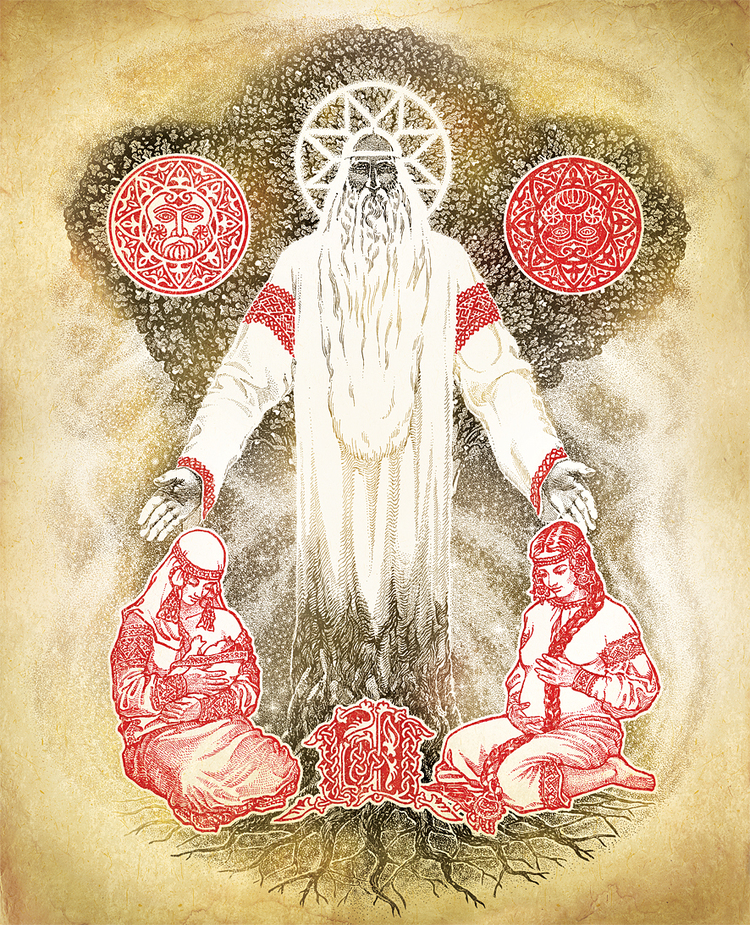
A portrait of the fertility god, Rod

Rod, Slavic God of Rain and Fertility


In some records of pre-Christian Slavic mythology, Rod is an ancient rain and fertility god, who along with his associates and female counterparts the Rozhanitsy, protects the home and childbirth. In other records, however, Rod is not a god at all, but rather a newborn child and the spirit of a clan's ancestors, who survives to protect the family.

Rod in Slavic Mythology

In general, little is known about pre-Christian Slavic religion, and what exists is murky, reported by Christian detractors who preferred that the pagan ways disappear. The Old Slavic word "rod" means "clan" and if he was a god at all, Rod provided rain and established the importance of the family. In the Baltic region, he is blended with Sviatotiv (Svarog) and said to have created people by sprinkling dust or gravel over the surface of the earth. Svarog was a supreme god, who was later to be replaced in Slavic mythology with Perun.

Most sources, though, associate Rod with the Rozhanitsy, the goddesses of fate and childbirth. The word "rod" is related to "roditeli," the word for "ancestors," itself drawn from the word for "family" or "clan." In medieval Slavic commentaries on the theologian Gregory of Nazianzenus (329–390 CE)'s 39th Oration, Rod is not a god at all, but a newborn child. Gregory was talking about the birth of the Christ child, and his 14th- and 15th-century Slavic commentators compared the Rozhanitsy to the child's attendants.

Rod's role as a supreme god was first mentioned in a late 15th/early 16th-century commentary on the Gospels. Historians Judith Kalik and Alexand Uchitel, however, argue that Rod was never a god, but rather an invention of the medieval Slavic Christians, who felt uncomfortable with the female-based and persistent cult of the Rozhanitsy.

Rod and the Rozhanitsy

Many references associate Rod with the cult of the Rozhanitsy, goddesses who protected the clan ("rod") from the vagaries of life. The women were in a sense the spirits of ancient ancestors, who were sometimes seen as a single goddess, but more often as multiple goddesses, similar to the Norse Norns, Greek Moirae, or Roman Parcae—the Fates. The goddesses are sometimes thought to be mother and daughter and sometimes mentioned as the consort of Rod.

The cult of the Rozhanitsy involved a ceremony held at the birth of a child, as well as larger ceremonies in the spring and fall every year. When a child was born, three women, usually elderly and representing the Rozhanitsy, drank from a horn and predicted the fate of the child. The Babii Prazdnik (Old Woman's Holiday or Radunitsa) was celebrated near the vernal equinox. A feast was prepared and eaten in honor of the dead; the women of the village decorated eggs and placed them on the graves of the deceased ancestors, symbolizing rebirth. Another feast was celebrated on September 9 and at the time of the winter solstice.

These practices extended well into the medieval and later periods, and the new Christians in Slavic society were very concerned about the persistence of this dangerous pagan cult. Despite the warnings of the church, people continued to worship the Rozhanitsy, often held in their sacred place, the bathhouse or spring, a site representing purification and regeneration.

Was Rod a God?

If Rod was ever a god, he was likely an ancient one, associated with rain and fertility, and/or a clan-based spirit that protected the home, equivalent to the Roman household gods which preserve the eternal kinship bond. If so, he may also have been a version of the domovoi, kitchen spirits that reside in people's homes.